
The California Community Colleges have partnered with Labster to provide virtual lab simulations to the colleges in its system. We invite you to join our webinar to help you get the most out of Labster this Fall semester.
Topics include:
- How Labster can help bring your science course online
- Implementing Labster into your course
- Overview of Labster best practices
- How / when to contact support
- Q&A
Register here: https://www.labster.com/webinars/cccs-fall-sep-8/
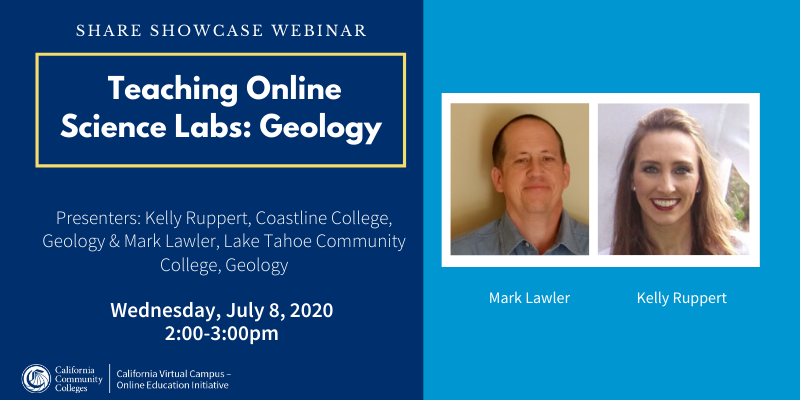 Kelly Ruppert (Coastline College) and Mark Lawler (Lake Tahoe Community College) both teach online geology lab courses, Kelly with a lab kit and Mark with materials students can find close to home. In addition, they are both collecting online resources that they can incorporate into their online courses. In this Share Showcase, both instructors will share the resources they have found and offer a brief tour of their classes, as they discuss ways to facilitate geology labs at a distance while encouraging student engagement and interaction.
Presenters: Kelly Ruppert, Coastline College, Geology & Mark Lawler, Lake Tahoe Community College, Geology
To receive meeting login credentials, register here: Teaching Online Science Labs: Geology Registration
For real-time captioning services, please contact support@cvc.edu at least five (5) business days prior to the event.
The California Community Colleges have partnered with Labster to provide virtual lab simulations to the colleges in its system. Join this webinar to learn best practices on engaging your biology students and reducing instructor workload with Labster’s virtual lab simulations. Labster’s Head of Content and Research, Ainara Lopez-Cordoba, will be joined by Paul Kasili, Professor of Genetics and Biotechnology at Bunker Hill Community College, who will share his experience using virtual lab simulations and his recommendations for other community college instructors.
Topics include:
How Labster can help bring your science course online
An overview of Labster’s biology simulations package
Tips, recommendations, and lessons learned from teaching with virtual labs
How to access Labster today
Register here: https://www.labster.com/webinars/cccs-teaching-biology-with-labster-virtual-labs/
The California Community Colleges have partnered with Labster to provide virtual lab simulations to the colleges in its system. Join this webinar to learn best practices on engaging your chemistry students and reducing instructor workload with Labster’s virtual lab simulations.
Labster’s Head of Content and Research, Ainara Lopez-Cordoba, will be joined by Joann Latorre, Assistant Professor of Chemistry, at Dona Ana Community College, who will share her experience using virtual lab simulations and her recommendations for other community college instructors.
Topics include:
How Labster can help bring your science course online
An overview of Labster’s chemistry simulations package
Tips, recommendations, and lessons learned from teaching with virtual labs
How to access Labster today
Register here
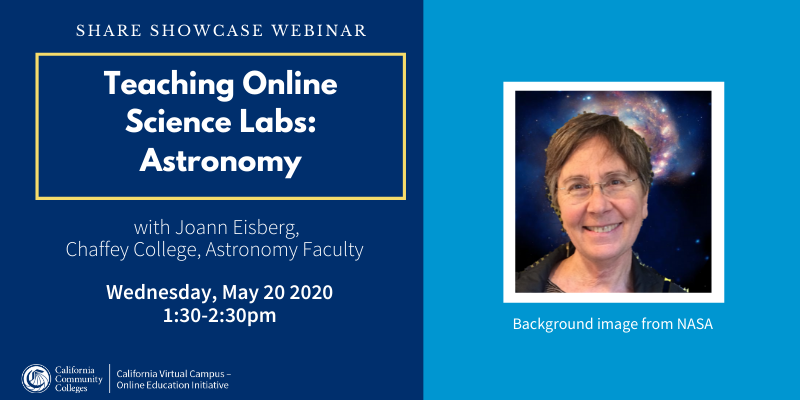
Online lab sciences leverage innovative strategies and technology to meet traditional lab learning outcomes. Joann Eisberg’s online astronomy labs use a variety of tools and resources that allow students to formulate scientific investigations, observe/measure phenomena, and gather/analyze/report qualitative and quantitative data. Students may choose among online simulations, online data sets, hands-on activities using common household items, and naked-eye observation, so that all can equitably participate. In this Share Showcase webinar, Joann will provide a brief tour of her fully online, fully OER course, share her teaching strategies, and survey other promising online astronomy lab resources.
Presenter: Joann Eisberg, Chaffey College, Astronomy Faculty
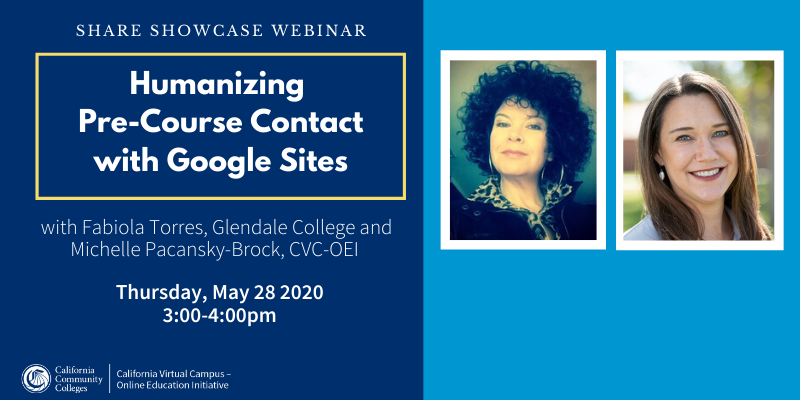
Humanized online teaching practices support the non-cognitive or affective dimensions of student learning. Many students who enroll in online courses, particularly those from minoritized backgrounds, do not successfully log in and complete the first week successfully. Weeks 0-1 comprise a high opportunity zone for increasing the percentage of students who succeed online.
In this session, Fabiola and Michelle will share examples of humanized practices from their online courses that use Google Sites to create a Liquid Syllabus and a Welcome Package for students. Sent before day one, (or embedded in online campus directories) students tap the link and are instantly taken to an accessible webpage that renders beautifully on their phone. By embedding a brief video of yourself at the top of the page, your students will be greeted by your warm, smiling face and feel supported to log-in and be successful in week one.
Presenters:
Fabiola Torres, Ethnic Studies Faculty at Glendale College and CVC-OEI/@ONE facilitator
Michelle Pacansky-Brock, Faculty Mentor, Online Teaching & Learning for CVC-OEI
Humanized online teaching practices support the non-cognitive or affective dimensions of student learning. Many students who enroll in online courses, particularly those from minoritized backgrounds, do not successfully log in and complete the first week successfully. Weeks 0-1 comprise a high opportunity zone for increasing the percentage of students who succeed online.
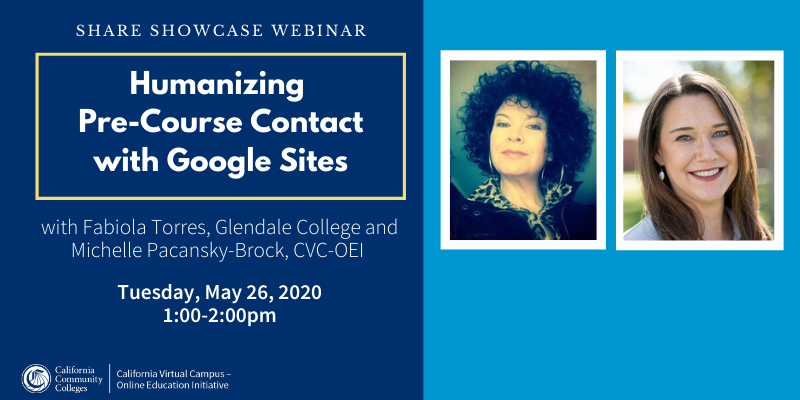
In this session, Fabiola and Michelle will share examples of humanized practices from their online courses that use Google Sites to create a Liquid Syllabus and a Welcome Package for students. Sent before day one, (or embedded in online campus directories) students tap the link and are instantly taken to an accessible webpage that renders beautifully on their phone. By embedding a brief video of yourself at the top of the page, your students will be greeted by your warm, smiling face and feel supported to log-in and be successful in week one.
Presenters:
Michelle Pacansky-Brock, Faculty Mentor, Online Teaching & Learning for CVC-OEI
Fabiola Torres, Ethnic Studies Faculty at Glendale College and CVC-OEI/@ONE facilitator
If you are teaching a course that is shifting online, click the link and join CVC-OEI’s instructional designer Shawn Valcárcel in Zoom to get your questions answered.
If you are teaching a course that is shifting online, click the link and join CVC-OEI’s instructional designer Cheryl Chapman in Zoom to get your questions answered.
If you are teaching a course that is shifting online, click the link and join CVC-OEI’s instructional designer Helen Graves in Zoom to get your questions answered.
