Join from PC, Mac, Linux, iOS or Android: https://cccconfer.zoom.us/j/618779581
Or iPhone one-tap (US Toll): +16699006833,618779581# or +13462487799,618779581#
Or Telephone:
Dial:
+1 669 900 6833 (US Toll)
+1 346 248 7799 (US Toll)
+1 646 876 9923 (US Toll)
+1 253 215 8782 (US Toll)
+1 301 715 8592 (US Toll)
+1 312 626 6799 (US Toll)
Meeting ID: 618 779 581
International numbers available: https://cccconfer.zoom.us/u/aoFuSyAwU
Or Skype for Business (Lync):
SIP:618779581@lync.zoom.us
As colleges continue to transition their student support services to the online environment; it is important that students have easy and direct access to the various virtual platforms available at their colleges. This webinar provides colleges with information and documentation on how to establish a one stop online student services hub in Canvas. Through an online student services hub, students will be able to find all needed support services in a single space.
 Required Course Review Myth Clarification: Before I start the main part of my post for this month, I want to clarify a misconception that has come to my attention. Any California community college can choose to adopt Canvas as their new course management system. Courses do not have to go through course review in order to migrate to Canvas. The use of the review process is purely a local college decision.
We hope that your college will consider reviewing courses and aligning them to the OEI Course Design Rubric, but there is no requirement to do so from the Online Education Initiative. If a college is putting courses in the OEI Course Exchange, however, then we do review those courses.
Colleges are also not required to participate in the Course Exchange if they adopt Canvas—again, it’s a local college decision. For more information about the exchange, see my earlier blog posts.
The Online Education Initiative Core Team
Have you seen us? We’ve been visiting colleges all over the state. I’ll bet you have met us! We are educators just like you and we truly care about the current and future students of California.
In years past, I was a CIS/Multimedia faculty member, Dean of Distance Education (DE) and co-Director of @ONE from the Mt. San Jacinto Community College District (CCD) and (long ago) Yuba College. Jory Hadsell, our Chief Academic Affairs Officer, is a former community college teacher and DE program director from the Los Rios CCD. Bonnie Peters, Chief Student Services Officer, hails from San Diego CCD where, as a counselor, she designed and directed an online counseling program. Michelle Pilati, Interim Chief Professional Development Officer, has been online-teaching faculty for many years, tenured at Rio Hondo and part-time at Mt. San Jacinto, Compton and Foothill colleges. Barbara Illowsky, Dean of Basic Skills & Open Educational Resources, is tenured faculty at De Anza College, and is one of the best online mathematics teachers around. Jayme Johnson, Director of Accessibility and User Experience, has been facilitating online accessibility for as long as I can remember. Joe Moreau, the OEI’s co-Executive Sponsor, has been art-faculty-turned-educational-technology-wizard, and has also been at three districts in the California Community Colleges (CCC) over his many years of service to students.
Many of us have been academic senate presidents and curriculum committee chairs, technology committee leaders, technicians and, most importantly, passionate educators in the CCC. This is our core team. We have taught psychology, art, multimedia production, business, mathematics, computer science and more over the years—all online. We are you.
Talk With Us
When you see us visiting at a college or at a conference, please introduce yourselves and let us know what resources we need to help you with your online teaching work. Our goal is to support the CCC in assisting students in their efforts to complete their educational goals. We are leading a huge student success initiative that is focused on making online learning effective and available across California. Talk with us!
I wanted to mention just a few of the upcoming activities of the initiative, and also let you know how things are generally going. I’ll start with some info about where you can find us in the next few months.
DE Coordinators & Staff Developers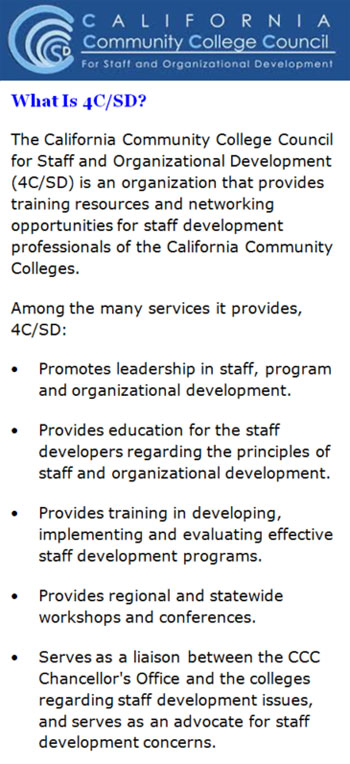
April 7-8, the OEI and the CCC Council for Staff and Organizational Development (4C/SD) will co-host a conference dedicated to faculty and staff who are responsible for providing professional development at their institutions. The conference will be held at the Doubletree Hotel in Claremont, Calif.
The OEI is participating in this year’s 4CSD annual conference, in part, to encourage DE coordinators in the CCC to join in. It often falls to the DE coordinators to develop and implement professional development activities for online educators and the sessions at this year’s conferences can provide ideas, strategies and content for that work. Our partners from @ONE will have a strong presence at the conference. I hope to see many of you there!
Registration is limited and can be accomplished at this link.
Time To Mega-Collaborate!
Later in April, from the 20th to the 22nd, we will be at the Aligning Partnerships for Student Success Conference hosted by the partnership of the Academic Senate for the California Community Colleges (ASCCC), the CCC Chief Instructional Officers (CCCCIO), the California Community College Association of Occupational Educators (CCCAOE) and the Chief Student Services Officers (CCCCSSAA).
As I have written here many times, the Online Education Initiative is about California’s community colleges putting their energy and knowledge together to benefit the students of our state. This conference is dedicated to that end. The recent developments of a variety of initiatives in the state have resulted in a natural synergy across our institutions, made possible by our ability to better communicate and to stay connected to develop educational strategies that benefit students. So it seems natural that the leadership groups in the state would come together for this event.
I am so looking forward to the time for us to be together in one place where we can share our effective practices with each other. It’s been said that a rising tide lifts all boats, and it seems that we are at that point in our history. Be there! You can register at any of the host-groups’ websites. I’ll let you choose your affinity.
 2016 Online Teaching Conference
I can’t mention conferences without promoting my favorite of all time, the Online Teaching Conference (OTC). This year it will again be at the San Diego Convention Center June 15-17. This is one of the only conferences I am aware of that is devoted to online teaching and learning. It is hosted by the CCC Chancellor’s Office technology projects and is definitely amazing! To register, please visit OnlineTeachingConference.org.
Meet Canvas At InstructureCon
Last but not least is InstructureCon 2016, July 19-21. We are grateful to Instructure for its support of our colleges through the rapid adoption processes our colleges have been participating in. (More info about that a little later in this post.) InstructureCon is the Canvas event hosted by Instructure every year. We are really happy that the OTC and InstructureCon are not happening at the same time, like they were last year! We will be there and hope those of you who are now using Canvas will be too! The Canvas folks will also be with us at the OTC. See the InstructureCon site for more information.
Coming To Visit You!
We are also visiting colleges often. We will be at Fullerton College on March 29, and at Santa Rosa Junior College on May 14. We have been to more than 50 colleges in the past year and will continue to set those visits as you request them! Additionally, we will be participating in the ASCCC regional online education meetings, April 8-9. For more OEI event news, please visit our site atCCCOnlineEd.org.
What’s Going On Within OEI?
There have been some recent additions to our staff. Because we are now deep into implementation of the resources for online learning, we needed to add project management support. Logan Murray and Jessica Hurtado have been hired to do a variety of activities having to do with resource implementation that range from providing the consortium with general support to working on the OEI website and social media presence! (Check out the CCC Online Education Initiative on Facebook!)
Additionally, we have a new associate in our Foothill-De Anza office, Martha Rubin. We are pretty confident that Martha will be the glue that keeps the OEI remote team together and will be available to answer your queries, too! You can contact her at support@ccconlineed.org. We are very happy to welcome these three to the initiative!
Canvas Adoption
“Wow!” doesn’t quite capture the expression that represents the rapid adoption of Canvas as the systemwide resourced CMS. As of this writing, 64 colleges have completed the paperwork required to adopt Canvas and are in various stages of implementation. Another dozen or so colleges are in the process of confirming their campus decisions or are in the consideration phase. We will be posting a list on our site in the next week or so.
This is an amazing show of solidarity across our colleges as a group working to offer effective online learning opportunities to our students. The rapid adoption has been handled really well by Canvas implementation staff. I have also noticed that, as we had hoped, the colleges that are adopting have been able to follow their own timelines, based on their ability to shift their CMS.
I was at a college last week to present an OEI overview in conjunction with a Canvas demo presentation. I have to say that I was impressed by the demonstration that our Canvas partners gave, including the clear, considerate and knowledgeable answers they provided to the faculty and staff participating in the event. If your college is considering adoption, requesting a Canvas demo is a must. We also have information about the process of CMS change consideration at our website. To find it, click Canvas CCMS under the Technology Resources menu.
Canvas Migration & Faculty Support Resources Available
I want to mention that we have new resource additions to our website. There is a section for faculty and staff resources focused on learning Canvas and migrating to the Canvas CMS. You can also find out how to access the cross-system community!
There are several migration guides that will help both staff and faculty understand how to bring courses from a currently used CMS to Canvas as well as concise information about how to use specific tools within Canvas. Check out these new resources. For specific use of Canvas tools, visit the Migration Support Page, where you will find step-by-step instructions for how to start using a variety of Canvas functions, as well as the Migration Support Guides.
Well, I am off now to register for conferences! See you there.
—Pat
Pat James is Executive Director of the California Community Colleges Online Education Initiative
 It’s hard to believe we are already at the end of 2015. This year for the California Community Colleges (CCC) Online Education Initiative (OEI) has been a busy one! In this blog post, I’d like to reflect on all we’ve accomplished and the results.
Some of the highlights of what the OEI has been working on:
- Over 11,000 students have been recipients of the student success resources we have developed through pilot courses. There are likely many more who have used the online learner readiness, tutoring resources, and under-prepared student resources and have benefitted from taking courses that have been influenced by the course design standards we developed.
- The OEI management team has presented at just about every conference and convening of educators both across the state and across the country and, just as in our online courses, relationship building has been critical to the success of the initiative’s goals.
- Members of the OEI and @ONE teams have visited over 40 colleges this year to discuss the initiative and/or provide training on applying the Course Design Rubric and/or Canvas use.
- Two new @ONE online courses have been developed and began to be offered in October. Canvas Train-the-Trainer workshops and Peer Online Course Reviewer trainings have been happening all over the state. Initial course reviews have been accomplished for over 70 pilot courses and are continuing through the re-review process.
- At this writing, over 30 colleges have committed to or are adopting the Canvas common course management system (CCMS). (The list grows by the day!) It seems that just yesterday we completed the CCMS section process. The selection was made in February. The negotiations ended in the summer and adoption began in July.
- We have held two pilot college consortium meetings with the pilot colleges represented, and will have completed an initial Course Exchange Memorandum of Understanding (MOU) by January of 2016. Those meetings have been highly charged with positive energy, and very productive. The Consortium now has a charter (with some help by our Steering Committee) and it has leaders! Wendy Bass from Los Angeles Pierce College and Will Breitbach from Shasta College have been elected as co-chairs for the group.
- A new OEI informational website has been developed and is now live at http://ccconlineed.org!
Our Guiding Principles
The OEI guiding philosophy has a foundation of doing what is best for students and as we reflect on the work over the past year, it is good to keep these guiding principles in mind as we go into the New Year:
- Always consider what is best for students.
- Engage in “agile” project management.
- Innovation is “messy”.
- Consider the big picture.
- Involve everyone in the process.
Personally, it is a privilege to be able to connect with so many of our CCC educators and in every case we find engaged, dedicated folks who understand what their work means to the students of our state. We are strongly fostering the idea that a student of any California community college is a student belonging to all of us. When we help educate our population we help the state of California be a better place to live.
As I write this post, I am reminded of what one of our students who served on the CCMS selection committee said to us in the selection meetings in February. When asked for her “take away” from the experience, she said “I always knew that my college teachers cared about me, but I never knew how much you all care about all of us [students] until now.” That caring for students is why I continue to work in this system.
 Course Exchange Target: Fall 2016
While there are many other important components of the initiative, the course exchange is on everyone’s mind these days. It certainly is one of the most complex tasks we are involved in!
It seems as though calling the idea of students taking classes at multiple colleges is not so much that of a course exchange as it is a student exchange. For the pilot of the exchange, all eight pilot colleges will have their students able to enroll across colleges and they will be offering courses for other school’s students, as well. All are participating as both “home” and “teaching” colleges. The exchange is still on target to launch the pilot in Fall 2016.
What is becoming clearer is that the purpose of the exchange will be to not only allow students to get the courses they need to complete in a timely way, but it will also allow for the colleges to develop a variety of collaborative programs across the Consortium.
The Exchange Mechanism
The technology required for the development of the exchange is moving rapidly forward. The developers at the CCC Technology Center are listening to our requirements and are doing a fantastic job of interpreting them within the development work. I am now very confident that a technical solution to solve the student “swirling” problem is possible!
The MOU that consists of the agreements among the eight exchange pilot colleges will be completed in January and form the foundation for the pilot of the exchange. Those agreements will be reviewed and revised throughout this year and beyond by the Consortium in collaboration with the Steering Committee, the OEI management team, and the CCC Chancellor’s Office staff. The results of the exchange trial in Fall 2016 will be critical for determining future policies and practices for the 24 pilot colleges and the system as a whole. The MOU is expected to evolve as we move past the pilot phases of the initiative.
Canvas Adoption Continues
The adoption of the Canvas CCMS by colleges in the system continues! There has been a surge in the last few months with colleges identifying timelines for adoption that fits their needs relative to the situations with current systems. We are continuing to visit colleges to discuss the possibilities for adopting, and are seeing new decisions to adopt happening every week.
If your college is considering the Canvas option, you will want to visit our Canvas site for further information. There, you’ll find a complete guide for how to have the conversation about CMS choice and how to implement should you choose to adopt Canvas.
The benefits to deciding to opt in to Canvas as the statewide CCMS system are many. Some of the immediate ones are:
- Your college will be part of a community of educators designing the future of the CCMS as it goes forward.
- Canvas is a CMS that is easy to use for students and faculty.
- The CCMS will be integrated among the services available across the systemwide initiatives including resources being piloted now (Online Tutoring and Student Readiness Modules, etc.) in the OEI.
- Professional development opportunities for using Canvas will be provided through the initiative at no cost to your college.
- Course migration support will be provided.
- If your college is hosting your current CMS, your college will no longer have costs associated with a self-hosting infrastructure.
- Upgrades will be completed on a systemwide basis.
- Additional resources will be integrated over time.
- Significant cost reduction of the cost of the CMS as it will be subsidized by initiative funds.
- The RFP/procurement process has been thoroughly conducted thus saving your college time in the adoption process.
Professional Development
Right now the focus of professional development is in two areas: aligning courses with the OEI Course Design Rubric and learning to use Canvas. The 12-week Online Education Standards and Practices course is scheduled to begin in Spring. Watch for further announcements from @ONE about that.
Working with the OEI team, @ONE has ramped up offering the four-week Canvas training course with up to six sessions planned for spring semester. They are working on the train-the-trainer module, as well, and are moving about the state teaching people to teach the @ONE Canvas course at their home colleges. Please see the announcement below for registration information:

Academic Integrity Resources
The Academic Integrity Work Group of the OEI Steering Committee has been working over the past several months to identify resources to enhance academic integrity in online courses. The focus has been to identify and secure tools that can seamlessly integrate into Canvas and provide two key ingredients for course integrity: online proctoring solutions that include student identity verification and tools for identifying and preventing instances of student plagiarism.
The work group and project leadership have been working with CollegeBuys, part of the Foundation for California Community Colleges, to facilitate the request for proposals and to secure agreements that provide the most aggressive pricing for the OEI and that can be extended to any California community college. Simply put: By identifying the best products and pooling our volume as a system, we create new possibilities for every college, student, and faculty member in our system.
Proctoring & Student Exam Authentication
The work group evaluated multiple proposals for online test proctoring and authentication and selected Proctorio as the best technology fit for our system. Pilot colleges will have access to Proctorio at no cost within their Canvas instances.
Proctorio provides faculty and students with a non-intimidating, simple workflow for capturing student identity and monitoring behavior during online tests. Faculty can easily adjust levels of required test security, with a wide variety of tools and options that include an ID check; lockdown browser; facial recognition technology; visual, auditory and computer-based behavior monitoring and capture; machine algorithms that analyze behaviors and metadata to flag unusual behavior by an individual student and across students taking a single exam; and an intuitive interface for reviewing flagged behaviors, including a downloadable incident log, among other features.
Another noteworthy feature is the ability to generate metadata across students and exams to flag suspected instances of fraud. With increasing scrutiny and prevalence of financial aid fraud in online courses, this is an important consideration. The contract is in the process of being finalized and executed this week. More information will be forthcoming shortly in a separate announcement.
The Academic Integrity Work Group also expressed a strong interest in providing a proctoring option to address situations in which face-to-face proctoring is needed. Therefore, as part of the OEI Steering Committee recommendation to move forward with Proctorio for online proctoring, the management team will also be working to put in place a network of participating colleges to form a face-to-face proctoring network. This geographically diverse network would allow any online CCC student to access a human proctor within a reasonable distance at no cost to the student. OEI staff will be soliciting interest and forming the agreements during the coming Spring 2016 semester.
Preventing Plagiarism
The Academic Integrity Work Group has outlined specifications for plagiarism prevention and detection software. The RFP process led by the Foundation did not lead to a vendor contract. However, the community college system has an existing pricing agreement with Turnitin.com that allows for discounted tiers as colleges pool their collective FTES volume. The features of Turnitin are largely in line with the functionality requested by the work group. Many colleges already use this agreement to license Turnitin with their existing CMS, including several pilot colleges.
The OEI management team is in the process of implementing a short-term agreement to license Turnitin for those pilot colleges that do not currently have a Turnitin license. The short-term agreement will provide licensing for Turnitin services between January and June for all courses migrated to the Canvas CCMS. We have received assurances from Turnitin that pilot colleges with existing contracts may undergo a second integration into Canvas with no additional licensing costs or fees.
To address longer term needs, the OEI is partnering with other systems and stakeholders to seek a longer term licensing agreement that reduces the cost of Turnitin. The existing CCC pricing expires this coming year, and we want to help secure an agreement with more aggressive pricing to benefit any California community college.
Online Counseling Network
After eight months of hard work and planning, the OEI has selected a meeting and collaboration platform, which will serve as the technological anchor and foundation of its Online Counselors’ Network Project, which is intended to serve online learners. On behalf of the OEI, the Foundation made the announcement of its intent to award the contract to Cranium Café, Salt Lake City, Utah.
With counselors trained in how to counsel online and on the use of the Cranium Café platform, the OEI’s Online Counselors’ Network will offer a new and efficient way to provide virtual counseling support services to online CCC students.
Initially counselors from participating OEI pilot colleges will be invited to participate in the network and will be offered the opportunity to utilize the Cranium Café platform to facilitate individual and group synchronous counseling sessions, online workshops, drop-in/walk-in sessions as well as online group presentations. Subsequently this service will be made available to any of the 113 community colleges interested in having trained online counselors and in using the platform to deliver online counseling for all online students.
The launch of the Online Counselors’ Network and the use of Cranium Café services is intended for mid-Spring 2016.
OEI Online Counselors’ Network Components
Educational Technology Platform:
- Partnership with Cranium Café online meeting and collaboration platform
Network Structure and Approach:
- Partner with participating OEI pilot colleges to establish a uniform approach to online counseling
- Create a community of online counselors trained in working with online students utilizing the same platform
Professional Development and Standards:
- Develop, deliver and standardize professional development training and materials aligned to the National Board of Certified Counselors standards for distance counseling professionals
Have a great holiday break!
–Pat
P.S. Thanks go to Bonnie Peters and Jory Hadsell for contributions made to this post.
